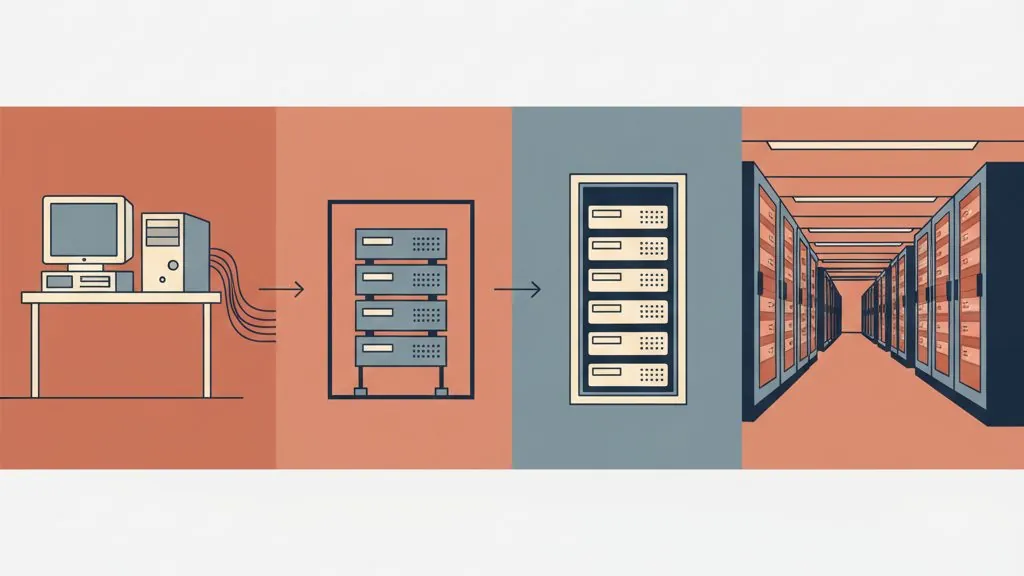
A Short History of Web Hosting: From Bedroom Servers to the Cloud
How keeping a computer switched on went from a hobbyist chore to a global utility, told through every era of web hosting from CERN to the cloud.
Every website you have ever loaded was served by a computer that someone, somewhere, had to keep switched on. That simple fact has stayed true for more than thirty years, but almost everything around it has changed. The story of web hosting is the story of how keeping a computer switched on went from a hobbyist's chore to a global utility you rent by the second.
The first servers were just computers that never slept
In 1991 a researcher at CERN named Tim Berners-Lee put the world's first website online. It ran on a NeXT workstation with a handwritten label asking people not to power it down, because powering it down would take the web with it. There was no hosting industry, no control panel, no monthly plan. A server was simply a machine you owned, connected to the network, and never turned off. If you wanted to publish, you ran the hardware yourself. The protocols that made it work are still with us, and you can still read the original specifications in the RFC archive that documents how the internet is built.
The free-hosting boom and the walled gardens of the 1990s
The web only became a mass medium once ordinary people could publish without owning a server. The answer, in the mid 1990s, was free hosting. GeoCities, founded in 1994, let anyone claim a page inside themed "neighborhoods" and fill it with whatever they liked. Angelfire and Tripod did much the same. You uploaded files over FTP, the host slapped a banner ad on your page, and your masterpiece lived at an address with somebody else's brand in it.
It was clumsy and it was glorious, and it taught a whole generation that a website was something you could just make. That same bargain still exists today in a more polished form, which is why free web hosting remains a sensible first rung for a personal project or a learning exercise.

Shared hosting and the rise of the control panel
The real unlock was shared hosting. Instead of one site per machine, providers learned to pack hundreds of sites onto a single server and split the cost between them. Suddenly a personal site cost a few dollars a month rather than the price of a dedicated line. Companies that are still household names in the industry, from DreamHost in 1996 to HostGator and Bluehost in the early 2000s, grew up on this model.
What made it usable for non-engineers was the control panel. cPanel arrived in the late 1990s and Plesk followed soon after, turning a Linux server's command line into a dashboard of buttons for email, databases and file uploads. The underlying recipe, Linux plus Apache plus MySQL plus PHP, became so common it earned its own acronym, LAMP, and it still powers a large share of the web. If you want the cheapest practical way to put a real site online, shared hosting is the direct descendant of this era, and you can compare plans across providers to see how little it now costs.
The dynamic web demands more power
As sites grew from static pages into applications, a single shared slot started to feel cramped. Forums, shops and content systems needed databases that could take a hammering and code that could run without a noisy neighbour stealing the processor. The answer was to give people a guaranteed slice of a machine, or a whole machine to themselves.
Virtualisation split one physical server into several isolated ones, and the virtual private server was born: root access and dedicated resources without the cost of renting the whole box. For the heaviest workloads, a dedicated server handed over the entire machine. Around the same time, in 2003, a small blogging tool called WordPress appeared. It would go on to run a remarkable slice of the web and to spawn an entire category of managed WordPress hosting tuned for that one job.
Then the cloud rewrote the rules
In 2006 Amazon did something strange for a bookshop. It started renting out the spare capacity of its own infrastructure, first as storage with S3 and then as on-demand servers with EC2. The idea that you could summon a server with an API call, use it for an hour and switch it off, broke the old assumption that hosting meant a fixed box you paid for whether you used it or not.

This is the model behind modern cloud hosting: pools of capacity spread across many machines, able to grow when traffic spikes and shrink when it fades. The physical reality underneath it is enormous, a global estate of data centres wired together by the networks and autonomous systems that move the traffic between them. Content delivery networks added another layer, caching copies of your site in edge locations close to your visitors so pages load quickly wherever they are.
Consolidation, managed everything, and the edge
The last decade has pulled in two directions at once. On one side, the industry consolidated, with large groups quietly acquiring many of the friendly hosting brands people grew up with. On the other, a wave of specialists made hosting almost invisible, from managed WordPress platforms to the static and serverless tools that deploy a site straight from a code repository. The newest frontier moves computation to the edge and, increasingly, asks servers to keep autonomous software running on their own, which is why AI agent hosting has started to look like its own category.
What the history tells you about choosing a host
Every era of hosting solved the same two problems in a new way: how to keep a computer reliably switched on, and how to let more people share the cost of doing so. Convenience has won at every turn, but the trade-offs never disappeared, they just moved. The renewal price, the performance ceiling, the question of who actually controls your data, all of it still matters.
That is the lens worth bringing to the decision today. Whether you start on a free tier, a budget shared plan or a cloud server, the same questions apply. If you want to see the full landscape in one place, browse the hosting directory, and if you are simply curious who runs the infrastructure behind a site you admire, our who is hosting this site tool will trace it for you in seconds.


0 Comments
No comments yet
Be the first to share your thoughts on this article.