
The Day OVH Burned Down
In March 2021 an OVH data centre in Strasbourg burned to the ground overnight, taking fourteen thousand servers and millions of websites with it. The night the cloud caught fire, and the lessons written in the ashes.
At around a quarter to one in the morning on 10 March 2021, a fire alarm went off in a data centre in Strasbourg, France. By four o'clock that morning an entire building had burned to the ground, taking roughly fourteen thousand servers with it. Millions of websites went dark, some of them forever. It was the moment a great many people learned, painfully, that the cloud is not a magical place in the sky. It is a building, and buildings can burn.
The host that grew up in the open
OVH, now OVHcloud, is not a minor player. Founded by Octave Klaba, it grew into Europe's largest hosting company and one of the few credible challengers to the American cloud giants, in part by building its own hardware and its own data centres rather than renting them. Its Strasbourg campus, known as SBG, sat beside the Rhine and housed a vast number of dedicated servers and cloud instances for customers across Europe. It was cheap, it was popular, and an enormous amount of the European web quietly depended on it.
The night SBG2 burned
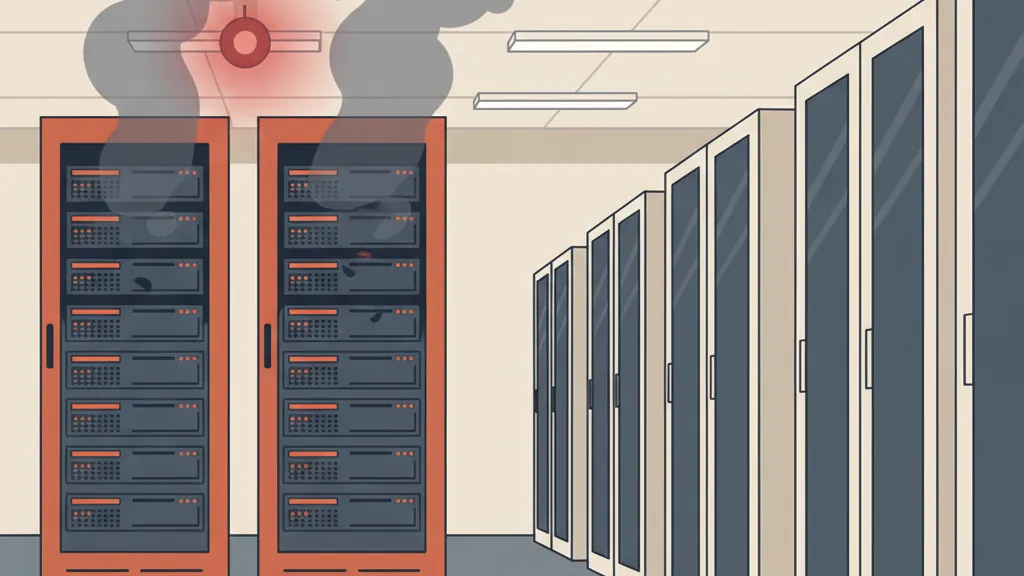
The fire took hold in the building called SBG2. Firefighters threw everything they had at it, but the structure was effectively lost within hours, and the neighbouring buildings were threatened badly enough that the entire site was shut down. When the smoke cleared, SBG2 was gone, and with it the 14,046 servers it had contained. Around 120,000 customer services were knocked fully or partly offline. By widely reported counts, something on the order of three and a half million websites across hundreds of thousands of domains were affected in a single night, from small businesses and game servers to government services.
The cruelest part: the data that was simply gone
Outages end. What made this one haunt people was the permanence. A great many customers discovered, in the worst possible way, that they had no backup, because they had assumed that paying a hosting company meant their data was safe by default. It was not. Some who had even paid for OVH's own backup options found that those backups had lived in the same Strasbourg campus, and in some cases the same threatened building, so they burned alongside the originals. Years of work for small businesses and hobbyists evaporated, not because the data was corrupted, but because the physical machines holding the only copy no longer existed.
What started it
The official investigation, led by France's BEA-RI, pointed to the building's power supply. The blaze appears to have begun in a room full of the large batteries and inverters meant to keep servers running during a grid failure, with a suspected water leak on an inverter as a possible trigger. The same uninterruptible power supply designed to prevent downtime may have helped cause the most catastrophic downtime in the company's history. The report was careful to say the precise cause could not be established with certainty. The design of the site, including its cooling and construction, drew hard questions afterward.
The lessons everyone wrote down that week
The fire became an instant case study, and the lessons were not new, they were simply ignored until a building burned to make them concrete.
- Your host is not your backup. A hosting provider keeps your site running. Keeping a copy of your data that survives the loss of that provider is your responsibility, not theirs.
- A backup in the same building is not a backup. The old rule of keeping copies in more than one physical place stopped being a dusty best practice and became the difference between a bad week and a closed business.
- Redundancy means geography. Real resilience means your data lives in more than one place that cannot burn down together, which is one practical reason the physical location of your servers, and how many regions a provider runs, genuinely matters.
The aftermath
OVH moved quickly to rebuild, offered affected customers help and free backup options, and, remarkably, went ahead with its stock market listing later that same year. The company survived, and so did most of its customers, but the events of that night permanently changed how the European industry talks about resilience. It also quietly punctured a comforting myth. The cloud had been sold, for years, as somewhere your worries went away. Strasbourg reminded everyone that cloud hosting is still just someone else's computer, in someone else's building, and that the responsibility for surviving its worst day never actually left you.
It belongs on the same shelf as the other hard lessons the industry keeps relearning. If you are weighing where to put something you cannot afford to lose, it is worth looking closely at a provider's data centre footprint and at how its network is spread, and worth choosing a host that makes backups and multiple regions easy rather than an afterthought. Our directory and plan comparison are a place to start, but the most important habit costs nothing: keep your own copy, somewhere else.


0 Comments
No comments yet
Be the first to share your thoughts on this article.