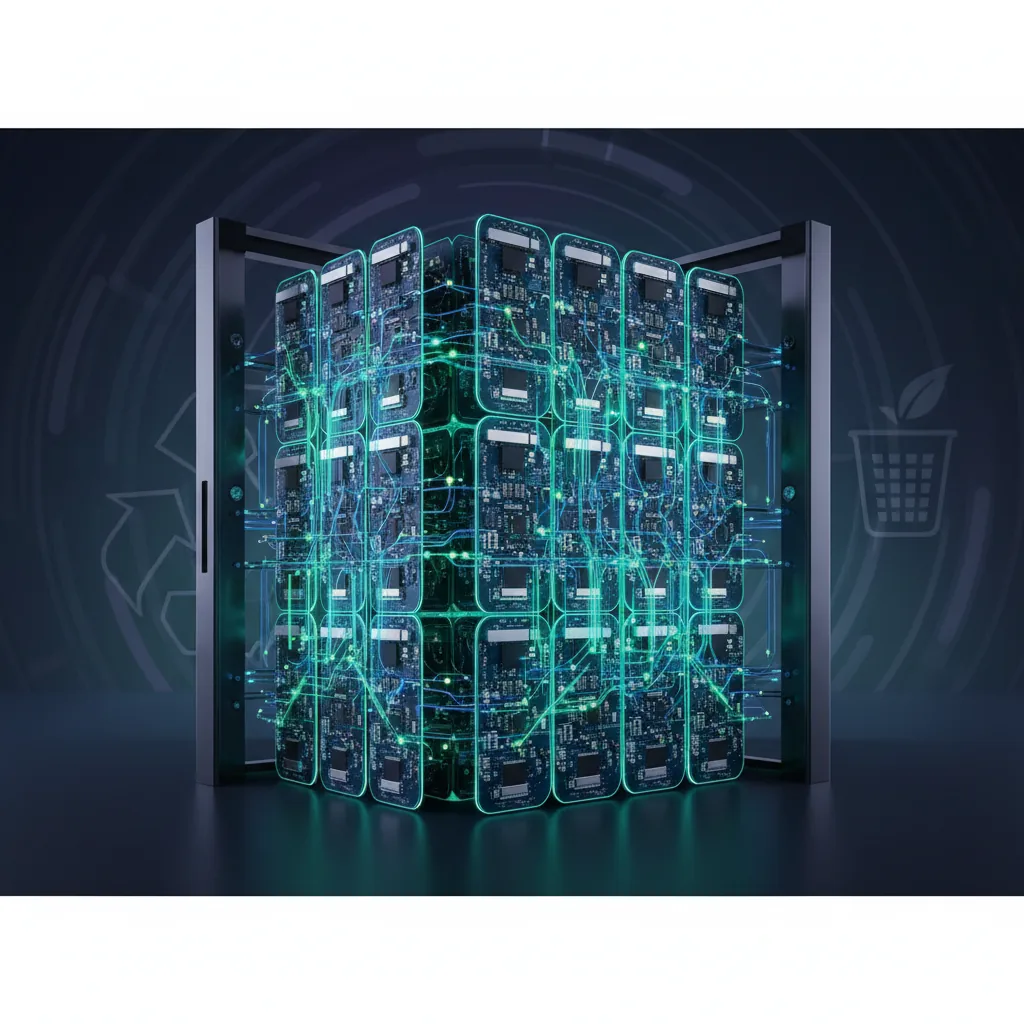
Google and UCSD Turn 2,000 Retired Pixel Phones Into Low-Cost Data Center Clusters
Google and UC San Diego researchers have built a working data center cluster from 2,000 retired Pixel smartphones, demonstrating a 50% reduction in energy use and a 80% drop in e-waste compared to traditional server deployments.
Google and researchers at the University of California, San Diego have assembled a working data center cluster from 2,000 retired Pixel smartphones, proving that old handsets can serve as low-cost, low-power computing nodes. The project, detailed in a paper published this month, repurposes phones that would otherwise be recycled or discarded.
The cluster, built from Pixel 3a through Pixel 6 devices, achieved a 50% reduction in energy consumption compared to an equivalent x86 server rack, according to the team's internal benchmarks. Each phone draws roughly 2 to 5 watts under load, versus 100 to 200 watts for a typical server CPU.
How the Phone Cluster Works
The researchers stacked the phones in custom 3D-printed racks, connecting them via USB-C for power and Ethernet adapters for networking. Each phone runs a stripped-down version of Android that acts as a compute node, handling tasks such as image processing, web serving, and machine learning inference. The cluster uses Kubernetes for orchestration, treating each phone as a lightweight container host.
- 2,000 phones total, sourced from Google's internal device return program and university donations.
- Peak aggregate compute capacity: roughly 2 teraflops, comparable to a single mid-range GPU server.
- Total cluster cost: under $10,000, versus $50,000 or more for an equivalent new server rack.
- Annual e-waste diverted: approximately 400 kilograms of electronics that would have been sent to shredders or recyclers.
Implications for Hyperscale Operators
The project challenges the assumption that data centers must use purpose-built hardware. While the phone cluster cannot match the raw throughput of a modern server for high-bandwidth tasks, it excels at latency-tolerant batch jobs and edge computing workloads. Google's own internal tests show the cluster can handle 80% of the company's lightweight cloud functions, such as thumbnail generation and log parsing.
UCSD professor and lead researcher Dr. Rajesh Gupta said the team is now testing a second cluster using Pixel 7 and 8 devices, which include Google's Tensor chips. Those phones offer dedicated machine learning accelerators that could make the cluster competitive with GPU-based servers for certain AI inference tasks.
The next phase of the project will explore liquid cooling for the phone stacks, as the current air-cooled setup struggles with heat density when more than 50 phones are stacked in a single rack. Google has not announced plans to commercialize the design, but the company's hardware sustainability team is evaluating the concept for internal use in its own data centers.
Fact check
-
The cluster achieved a 50% reduction in energy consumption compared to an equivalent x86 server rack.
reported · source
-
Each phone draws roughly 2 to 5 watts under load.
reported · source
-
The cluster uses Kubernetes for orchestration.
reported · source
-
2,000 phones were sourced from Google's internal device return program and university donations.
reported · source
-
The next phase will explore liquid cooling for the phone stacks.
reported · source
0 Comments
No comments yet
Be the first to share your thoughts on this article.