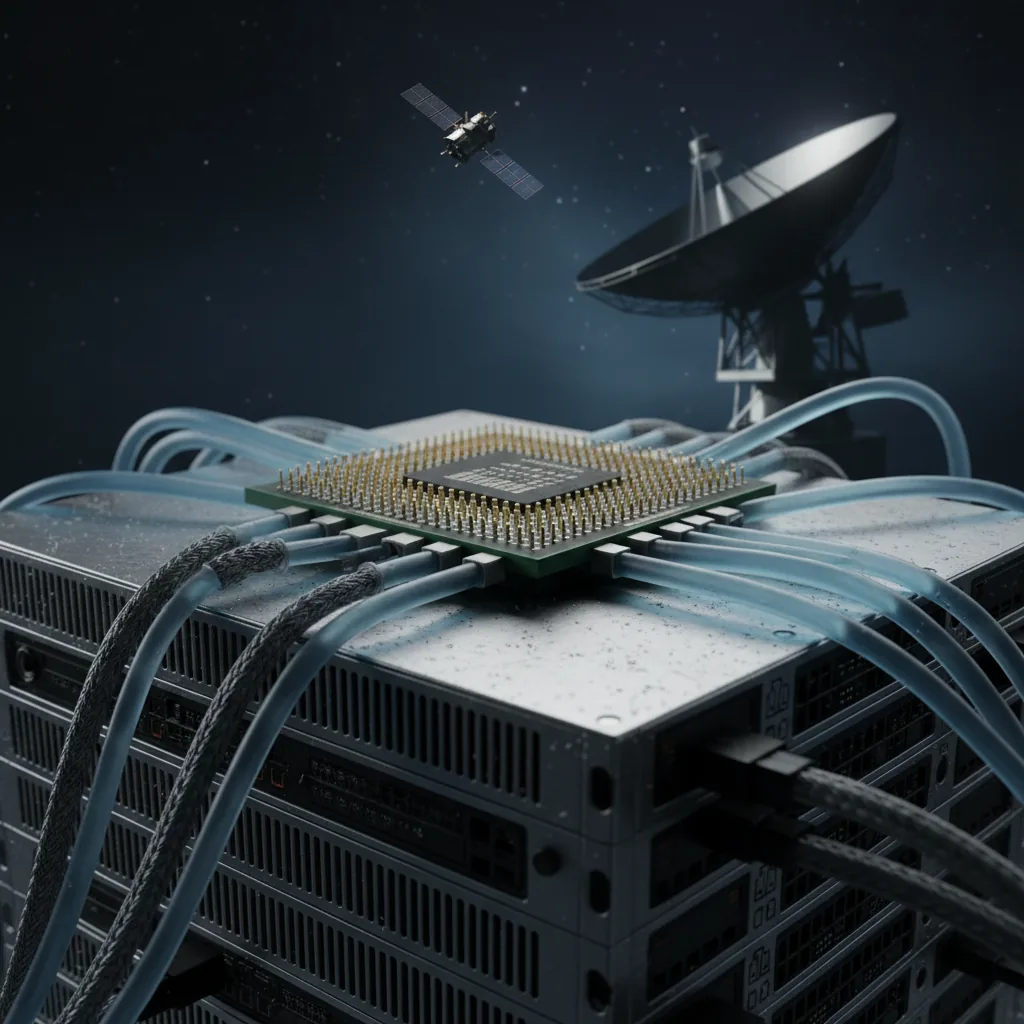
Orbital data centers draw skepticism from industry as SoftBank CEO questions cost and timeline
SoftBank CEO Masayoshi Son has publicly questioned Elon Musk's orbital data center plans, arguing they are too costly and too far off to solve today's compute crunch. The critique lands as hardware makers push terrestrial power envelopes toward 500W per chip.
SoftBank CEO Masayoshi Son has publicly challenged Elon Musk's vision for orbital data centers, arguing the space-based systems will not deliver cost savings or arrive in time to address the current AI compute shortage. Speaking at a recent shareholder meeting, Son said the next few years matter far more for the AI race than what might happen a decade from now.
The comments, reported by TechCrunch on June 27, 2026, arrive as terrestrial data center hardware pushes power and density to extreme levels. Intel's next-generation Nova Lake CPU is expected to consume up to 474 watts at peak, and enthusiast motherboards on the new LGA1954 platform may require three 8-pin power connectors to feed a single socket.
Cost, timeline, and engineering hurdles in orbit
Son's skepticism reflects a broader industry unease. Orbital data centers require satellite constellations whose individual units must be replaced every few years, a recurring expense that undercuts any long-term savings from free solar energy or cooling in space. SpaceX has been pitching its compute-as-a-service offering backed by Starlink infrastructure, and has signed at least one post-IPO deal to rent capacity to a smaller player. But critics on the TechCrunch Equity podcast pointed out that launch costs, radiation hardening, and latency will remain structural barriers for years.
Key factors underpinning the debate include:
- SpaceX controls roughly 80 to 90 percent of the global launch market, giving it a unique position to build orbital assets.
- SoftBank itself has a history of funding moonshots, making Son's pushback notable as a signal from a major industry investor.
- Terrestrial data center construction faces NIMBY opposition and grid constraints, pushing hyperscalers to consider alternatives.
- Intel's Nova Lake 52-core flagship, expected in the 2026-2027 timeframe, will demand cooling and power delivery far beyond what current rack designs accommodate.
Terrestrial hardware sets a different pace
While orbital concepts generate headlines, the immediate compute crunch is being met with denser, hungrier silicon. Supermicro displayed its Super AI Station at Computex 2026, a system built around Nvidia's GB300 Grace Blackwell architecture that packs 208 billion transistors into a single workstation-class package. The system is now shipping alongside the Nvidia DGX Station, giving AI researchers access to ultra-high-bandwidth memory and GPU clusters on premises.
The 474W thermal design power of Intel's Nova Lake presents its own challenge: data center operators must upgrade power distribution and liquid cooling loops to handle per-socket loads that rival some electric heaters. Motherboard vendors are already planning three EPS12V connectors for high-end boards, a standard that was once reserved for dual-socket servers.
For now, the industry is betting on terrestrial density gains rather than a leap to orbit. Son's question, even if ironic given SoftBank's own aggressive bets, underscores a practical reality: the next two years of AI demand will be met by chips like Nova Lake and systems like the GB300, not by satellites.
Fact check
-
Masayoshi Son argued at a recent SoftBank shareholder meeting that orbital data centers will take too long and won't cut costs.
reported · source
-
SpaceX controls roughly 80 to 90 percent of the global launch market.
reported · source
-
Super Micro's Super AI Station uses Nvidia's GB300 architecture and has 208 billion transistors.
reported · source
-
Intel's Nova Lake flagship CPU will have a 474W PL2 power limit.
reported · source
-
Intel's LGA1954 platform may require three 8-pin power connectors on high-end motherboards.
reported · source
Source reporting (3)
- TechCrunch · SoftBank’s CEO isn’t the only one with questions about Elon Musk’s orbital data center hype
- ServeTheHome · Taking an Up-Close Look at the Supermicro GB300 Super AI Station
- Tom's Hardware · Intel's next-gen 52-core Nova Lake CPU could pull up to 474W — high-end LGA1954 motherboards may need three 8-pin power connectors to feed the monster


0 Comments
No comments yet
Be the first to share your thoughts on this article.