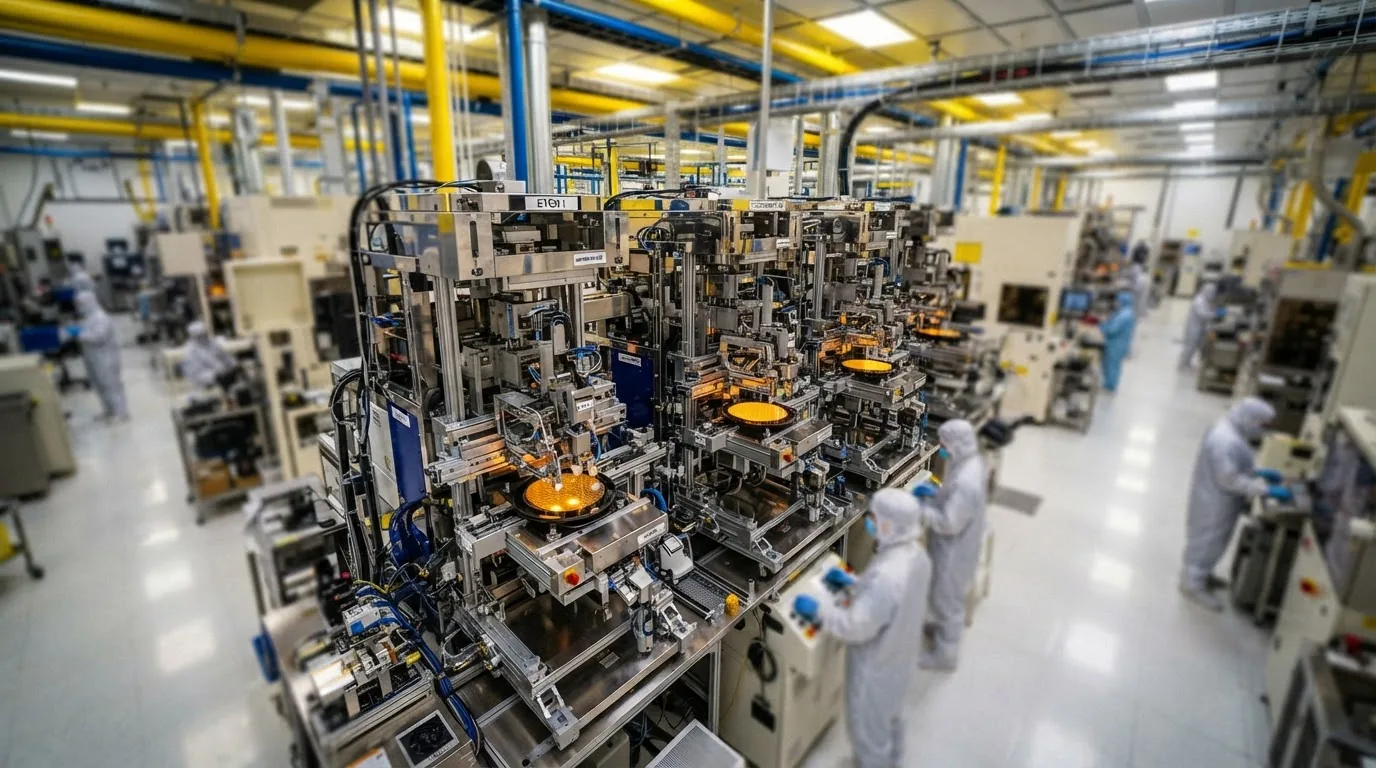
Memory Chip Capacity Race Intensifies as AI Demand Strains Supply Chains
Memory chip makers face pressure to expand capacity as AI demand surges, with SK Hynix racing to meet demand through 2027 and TSMC committing $100B to US production. Investors worry about a boom-bust cycle.
Memory chip makers are racing to expand capacity as AI demand strains supply chains, with SK Group Chairman Chey Tae-won warning that governments are intervening to secure domestic supply and TSMC committing $100 billion to US production. The push comes as Moonshot AI paused new subscriptions for its Kimi K3 model after demand nearly exceeded capacity.
SK Hynix must accelerate capacity expansion to meet demand that Chey expects to far exceed supply through 2027, according to The Korea Herald. The company's shares have fallen amid investor fears that massive investment plans could lead to oversupply, though some analysts believe AI demand will break the industry's historical boom-and-bust cycle, the Financial Times reported.
TSMC and SK Hynix Lead Expansion
TSMC CFO Wendell Huang said the company will use its new $100 billion US commitment to expand Arizona capacity, citing a "multi-year demand mega trend" in a CNBC interview. The investment follows TSMC's earlier $65 billion pledge for three Arizona fabs. SK Hynix, meanwhile, is building new facilities in South Korea and considering overseas sites.
- SK Hynix plans to invest $74.6 billion through 2028 in memory production, with a focus on HBM (high-bandwidth memory) for AI accelerators.
- TSMC's Arizona expansion will include advanced 3nm and 2nm process nodes, targeting production by 2028.
- Moonshot AI paused new Kimi K3 subscriptions on July 19, citing GPU capacity limits after demand spiked over 48 hours.
- South Korea's $4 trillion equity market now serves as an early indicator for global AI stock sentiment, with SK Hynix and Samsung moves rippling worldwide.
- Governments in the US, South Korea, and Japan are offering subsidies and tax breaks to secure domestic chip production.
Investor Concerns and Market Dynamics
Despite the capacity push, memory chip shares have fallen as investors worry that rapid expansion could lead to oversupply, repeating past cycles. The Financial Times reported that some analysts argue AI demand is structurally different, driven by hyperscaler data center buildouts and edge AI devices. However, the risk remains that if AI adoption slows, excess capacity could depress prices.
What comes next depends on whether AI demand sustains its current trajectory. SK Hynix and TSMC are betting billions that it will, but the memory industry's history suggests caution. For now, the race is on, and governments are placing their own bets on domestic chip production as a matter of economic security.
Fact check
-
SK Group Chairman Chey Tae-won said memory demand will far exceed supply through 2027.
reported · source
-
TSMC CFO Wendell Huang said TSMC will use its new $100B US commitment to expand Arizona capacity.
reported · source
-
Moonshot AI paused new subscriptions for Kimi K3 after demand nearly exceeded capacity.
reported · source
-
Investors worry capacity expansion could lead to oversupply, while others believe AI demand will break the boom-and-bust cycle.
reported · source
-
South Korea's equity market serves as an early indicator for global AI stock sentiment.
reported · source
Source reporting (6)
- Techmeme · As memory shares fall, investors worry capacity expansion could lead to oversupply, while others believe AI demand will break the industry's boom-and-bust cycle (Financial Times)
- Techmeme · SK Group Chair Chey Tae-won says the memory shortage has prompted governments to intervene for domestic industries, and SK Hynix must expand capacity faster (Moon Joon-hyun/The Korea Herald)
- Techmeme · TSMC CFO Wendell Huang says TSMC will use its new $100B US commitment, announced last week, to expand its Arizona capacity amid a "multi-year demand mega trend" (Jenny Lee/CNBC)
- Techmeme · Moonshot AI pauses new subscriptions, saying that over the past two days Kimi K3 demand nearly passed the limit of its capacity, and also reworks its plan tiers (@kimi_moonshot)
- The Next Web · Korea’s AI chip market is now the opening bell for global stocks
- Techmeme · Filing: Zhongji Innolight, China's leading optical transceiver maker, aims for an $8B Hong Kong IPO, the city's largest since Alibaba's $12.9B debut in 2019 (Dave Sebastian/Bloomberg)


0 Comments
No comments yet
Be the first to share your thoughts on this article.