Data Center Power Shifts: AI Demand Drives On-Site Renewables, Battery Storage, and National Grid Plans
A startup raises $27M for behind-the-meter renewable systems, GM enters sodium-ion battery storage for data centers, and China plans a $295B national AI data center grid.
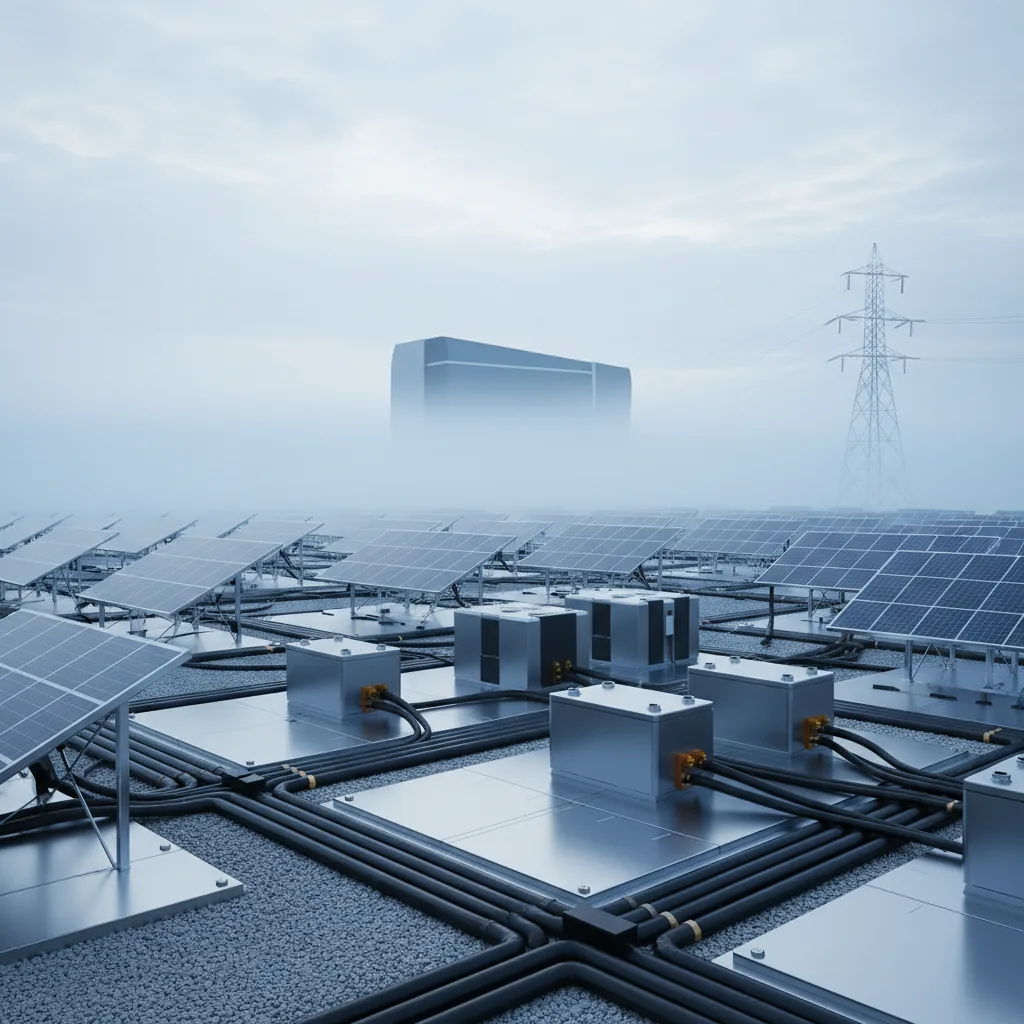
A data center power startup called TAR has raised $27 million in seed funding to build modular, behind-the-meter renewable energy systems that can be deployed in as little as three months. The company is planning a 10 MW pilot project and expects to deliver its first customer deployment, to an unnamed neocloud offtaker, at roughly twice that capacity.
TAR claims it has a pipeline of more than 200 MW of capacity lined up for 2027 and several additional gigawatts for 2028. The startup's value proposition centers on speed and avoidance of grid interconnection queues, lengthy permitting cycles, and on-site labor bottlenecks. TAR co-founder Pat Becker told Forbes the system will combine solar, batteries, wind, and simple cycle gas turbines for backup, with a target nameplate capacity that far exceeds the 10 MW figure.
Automakers and Sodium-Ion Enter the Picture
General Motors is entering the data center energy storage market. The auto giant has partnered with Peak Energy to build large-scale sodium-ion batteries designed for utilities and data center facilities. Sodium-ion chemistry uses more abundant materials than lithium-ion, which could lower costs and reduce supply chain risk. The move marks a diversification for GM, which is already active in electric vehicle batteries and is now targeting stationary storage for the power-hungry data center sector.
- GM and Peak Energy will develop sodium-ion battery systems for data center backup and grid support.
- Sodium-ion batteries avoid lithium and cobalt supply constraints.
- The partnership signals growing industrial interest in data center power infrastructure.
China's $295 Billion National Data Center Grid
China is planning to spend nearly $295 billion on a national data center grid that would rely heavily on domestically manufactured semiconductors. The infrastructure project is intended to support AI workloads at a national scale and is being backed by government financing and China's three state-owned telecom operators. The plan calls for networked data centers across multiple regions, powered by Chinese-made silicon, in a bid to outperform U.S. AI infrastructure. This centralized approach contrasts with the decentralized, on-site power solutions emerging in the United States.
Grid Constraints and the On-Site Power Trend
The flurry of activity around on-site power generation, battery storage, and national grid planning reflects a single underlying reality: electric grid capacity is not keeping pace with data center growth. A recent analysis published by Data Center Knowledge notes that on-site power solutions, including behind-the-meter renewables and gas turbines, are increasingly used to bypass multi-year interconnection delays. TAR's offering fits into this trend, as does GM's battery play and China's state-driven mega project. The U.S. approach favors private capital and modular deployment; China's favors central planning. Both aim to unlock power for AI infrastructure within a few years, not a decade.
TAR's pilot site remains undisclosed. The company said it expects to use gas turbines for only a few weeks per year, if at all, relying primarily on renewables. Becker acknowledged that TAR's energy pricing is not cheaper than grid power, but said it is far below the $150 to $160 per MWh seen in some behind-the-meter PPAs. The first commercial deployment is expected before the end of 2026.
Fact check
-
TAR raised $27 million in seed funding for behind-the-meter renewable energy systems for data centers.
verified · source
-
TAR is planning a 10 MW pilot project and has a pipeline of over 200 MW for 2027.
reported · source
-
GM and Peak Energy are partnering to develop sodium-ion batteries for data centers and utilities.
reported · source
-
China plans to spend nearly $295 billion on a national data center grid powered by domestic chips.
reported · source
-
On-site power solutions are increasingly used to bypass grid interconnection delays for data centers.
verified · source
Source reporting (11)
- Data Center Dynamics · TAR raises $27m to build behind-the-meter renewable power systems for data centers - report
- TechRadar Pro · China wants to spend nearly $300 billion on a national data center grid — all powered by domestically made silicon and looking to outperform the US
- TechRadar Pro · GM is getting in on the data center game — auto giant will start building huge sodium-ion batteries to help with energy storage
- Data Center Dynamics · DC Blox data center in eastern Indianapolis receives recommendation for approval
- Data Center Knowledge · From Grid Constraints to On-Site Solutions: The Future of Data Center Power
- Data Center Dynamics · Bharti Airtel shareholders vote in favor to increase Airtel Africa stake
- The Stack · Rackspace’s "30MW" AMD deal: The devil's in the details
- Data Center Dynamics · Orca deploys quantum computer in Japan
- Ars Technica · Among the large new rockets Amazon was counting on, only Europe has delivered
- The Next Web · A Czech AI startup says it can detect drones by sound for €150 per sensor, and it wants to wire up power grids first
- Slashdot · France To Stop Certifying Products Without Quantum-Safe Encryption
0 Comments
No comments yet
Be the first to share your thoughts on this article.