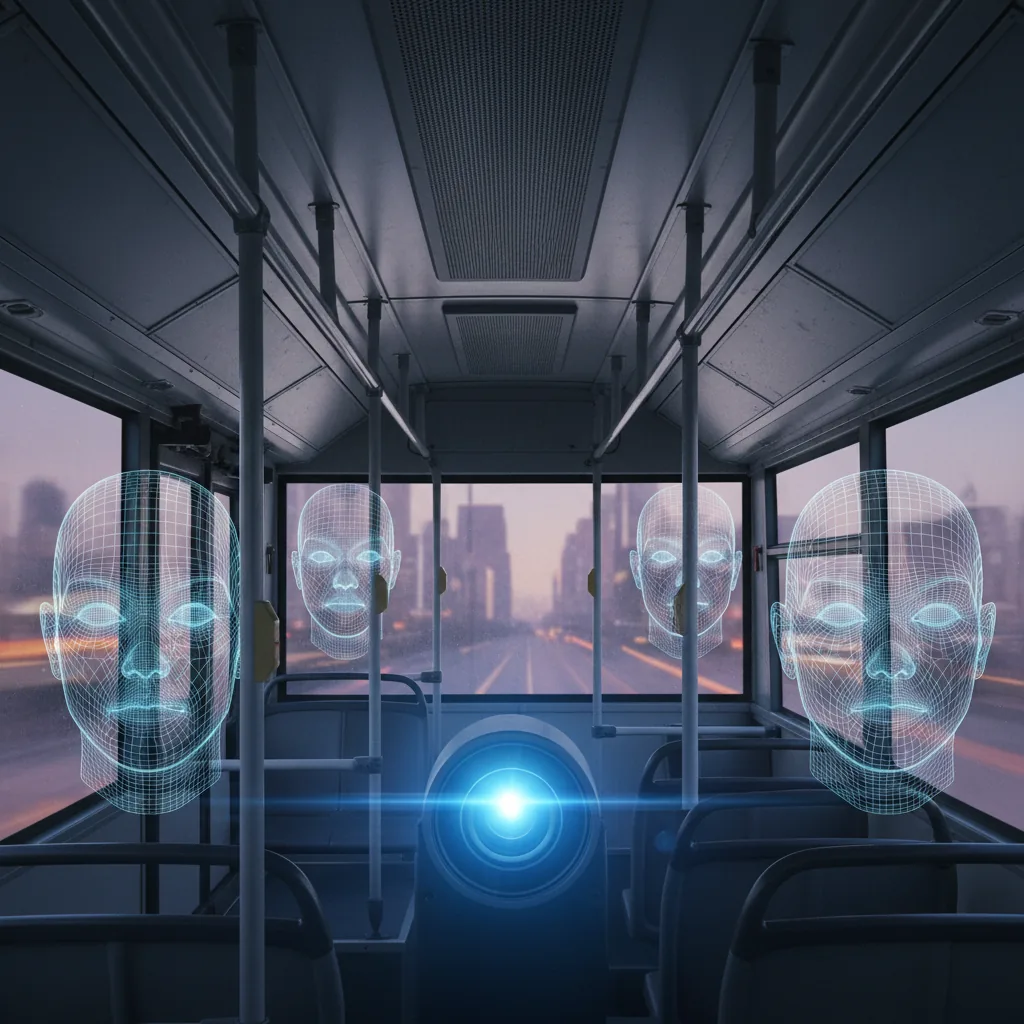
Kansas City Buses Get Facial Recognition as Pentagon and White House Push AI Boundaries
Kansas City is equipping buses with facial recognition to identify banned riders and missing persons. Meanwhile, 1.5 million Pentagon workers use GenAI.mil for Congress reports, and the White House delays a voting-machine vulnerability study.
Kansas City, Missouri, is preparing to equip cameras on some public buses with facial recognition software capable of identifying passengers who appear on a list of banned riders or missing persons. The effort, reported by the Associated Press on June 21, 2026, positions the city as a test case for live AI surveillance on U.S. public transportation.
The Kansas City Transportation Authority is moving forward with local and federal money after the state of Missouri declined to help fund the project due to concerns about the facial recognition component. Tyler Means, the authority's chief mobility and strategy officer, said, "We've always had cameras on our buses. It's just new technology." Images captured aboard buses will be checked against active alerts for missing persons, banned riders, or law enforcement watch lists. Video footage will be archived on a local server for up to five years.
Pentagon Pushes Generative AI for Internal Workflows
At the federal level, the Pentagon is embracing generative AI for administrative tasks. According to a TechRadar Pro report, 1.5 million Pentagon workers now use GenAI.mil, a platform that Chief Technology Officer Emil Michael encourages staff to employ for generating reports to Congress. Michael told employees to "use GenAI.mil, do the best you can," signaling a broad mandate for AI adoption in military bureaucracy.
- GenAI.mil is used by 1.5 million Department of Defense personnel.
- The platform generates reports, memos, and other documents for Congress.
- Officials acknowledge risks but prioritize speed and efficiency.
- Critics warn of potential inaccuracies and security vulnerabilities in AI-generated content.
- The move follows broader federal efforts to integrate AI into government operations.
White House Delays Election Security Report Amid Midterm Concerns
In a related development, the White House has delayed the release of a study on U.S. voting-machine vulnerabilities until after the 2026 midterm elections, according to Reuters. The report, which examines potential weaknesses in election infrastructure, was expected to inform security upgrades. The delay has drawn criticism from cybersecurity experts who argue that transparency is essential for public trust. The decision underscores the tension between election security and political timing, as AI-powered threats to voting systems remain a growing concern.
These three developments highlight the expanding role of AI in government and military operations, from local transit surveillance to federal report generation and election security. Privacy advocates, including the American Civil Liberties Union, have raised alarms about the Kansas City project, with Jay Stanley calling it a line that "until recently has never really been crossed." The Pentagon's GenAI.mil deployment and the delayed voting-machine study add to the debate over how quickly and transparently AI should be adopted in public institutions. As these initiatives move forward, the balance between efficiency, security, and civil liberties will continue to be tested.
Fact check
-
Kansas City is equipping public buses with facial recognition software to identify banned riders and missing persons.
reported · source
-
1.5 million Pentagon workers use GenAI.mil to generate reports for Congress.
reported · source
-
The White House delayed release of a voting-machine vulnerability study until after the 2026 midterm elections.
reported · source
Source reporting (3)
Related Articles

Nikita Bier steps down as X head of product after a year, returns to advisory role
Aug 6, 2026

Amazon, Google, Microsoft on track to spend nearly $600B on AI infrastructure in 2026
Aug 4, 2026

OpenAI counters Apple trade secret lawsuit with chat logs showing Apple employees sought help from ex-colleague
Aug 4, 2026
0 Comments
No comments yet
Be the first to share your thoughts on this article.